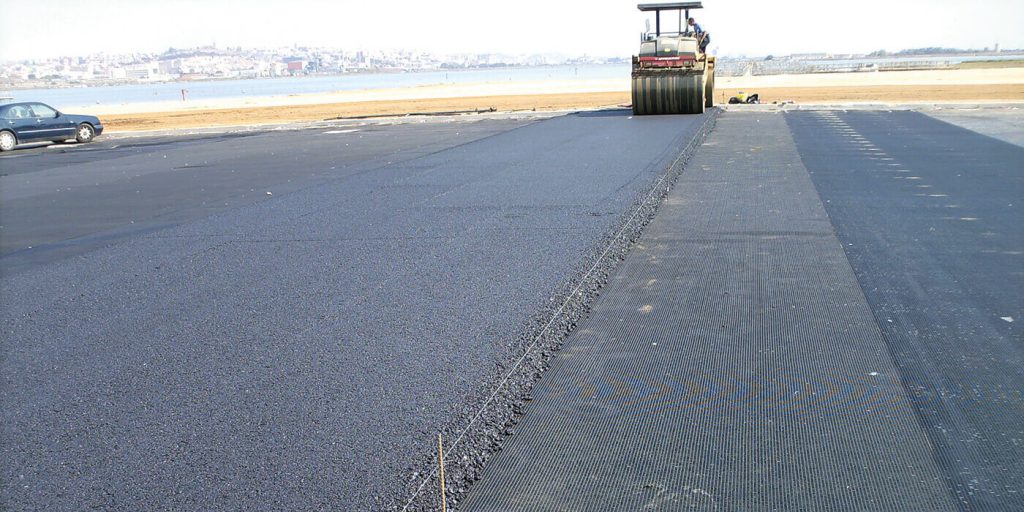
Landfill capping
SintexMat® and SintexDrain® for landfill capping in Ravenna
SintexMat® and SintexDrain®: drainage geocomposites and geomats for landfill capping.
Problem
The non-hazardous waste landfill, owned by HERA and located on Via Romea Nord (Ravenna), reached the end of its operational life. This raised the issue of permanently closing the perimeter embankments using geosynthetic materials. The Province of Ravenna approved the geosynthetic solution for the embankment for safety reasons.
The work therefore involved:
• evaluating the type of drainage geosynthetics to achieve a basic equivalence with a layer of natural material;
• evaluating the equivalence of synthetic geocomposites to be used as an alternative to the waterproofing layer;
• evaluating the overall stability of the cover package adopted.
Italian Legislative Decree 36/2003 specifies a minimum thickness of 1.00 m for the covering topsoil. This thickness promotes the growth of ground cover plants for environmental restoration and provides adequate thermal protection to the barriers below. Engineers nonetheless chose a 30 cm layer of soil, for the following reasons:
• a 30 cm thickness is adequate for the growth of grassy plants with limited root systems;
• the water erosion protection function is ensured by the ground cover;
• the thermal barrier function mainly concerns the mineral layers, which can be replaced by geomembranes or bentonite geocomposites.
Solution
To ensure the stability of the embankment, engineers considered several factors:
• the average slope of the landfill’s side embankments;
• the average thickness of the covering topsoil;
• the friction angles between the geosynthetic surfaces of the capping and between the geosynthetics and the soil.
Based on these factors, they chose to use SintexMat® R35/20, a three-dimensional geomat for erosion control. For the thickness of the granular soil to be replaced (50 cm) and the slope of the embankment (30°), engineers instead chose to use SintexDrain® GNG5. This drainage geocomposite serves both as a biogas capture layer and as a rainwater drainage layer.
Static and seismic analyses were carried out using the Ling and Leshchinsky (1997) approach. For this type of work, this method is considered among the most complete calculations based on limit equilibrium. For the hydraulic aspects, Darcy’s law was used instead.


Client:
HERAMBIENTE SPA
DISCARICA DI RAVENNA
Contractor:
CBR SPA COOPERATIVA BRACCIANTI RIMINESE
Products:
• 86.400 m2 of SintexDrain® GNG5 drainage geocomposite;
• 32.000 m2 of SintexMat R35-20 geomat.
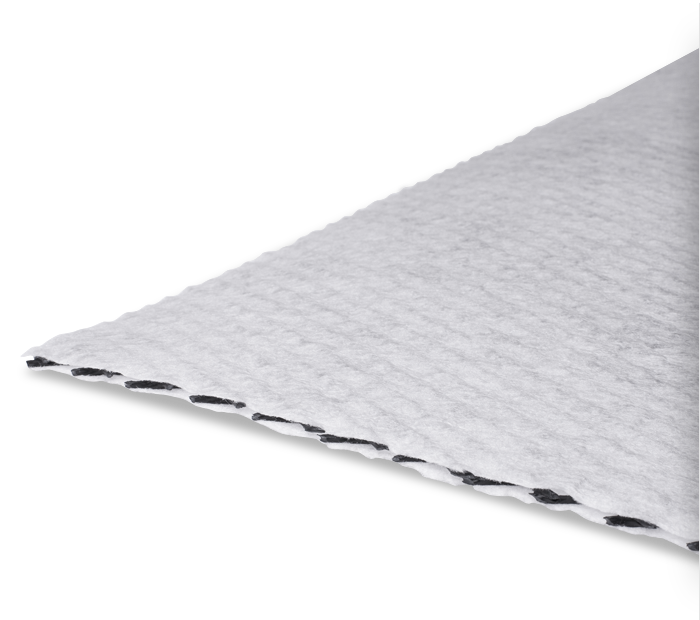

Application

You might also be interested in...
Coastal defence on the Black Sea