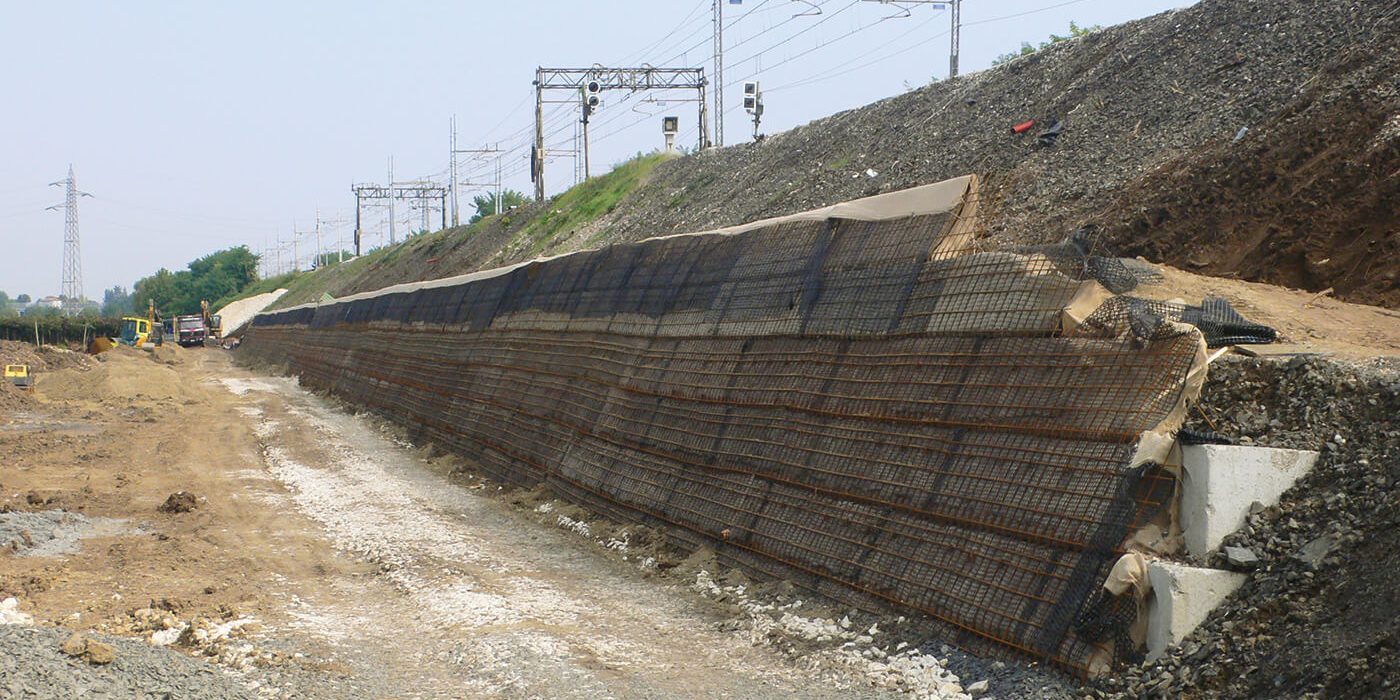
Reinforced soil structure, Milan-Venice railway
Edilgrid® and SintexMat® for the Milan-Venice railway embankment
Edilgrid® and SintexMat®: geogrids and geomat for reinforcing and controlling erosion on the railway embankment.
Problem
The Milan-Venice railway line, in the section between the Lonigo and Montebello stations, runs above ground level. The line runs on an embankment with an average height of 6-7 m and slopes with an average inclination between 26° and 35°.
Starting from 1985-1986, cracks were detected along the edges of the slope. This led to an extensive geotechnical investigation, aimed at determining the geomechanical characteristics of the embankment. The investigation formed the documentary basis needed to determine and plan subsequent stabilization work.
The analyses revealed that the cracks could be attributed to:
• construction of the embankment using clayey or silty-clay material;
• the presence of rainwater infiltration inside the embankment, particularly in sections previously subjected to stabilization work (jet grouting);
• possible erosion and infiltration effects at the toe of the embankment, caused by runoff water with occasionally significant flow rates and velocities.
Solution
The stabilization work included three elements:
• collecting rainwater on the platform;
• controlling erosion on the upper slope, inclined at 34°;
• building a reinforced soil structure at the base of the embankment, to limit its movement.
Engineers controlled erosion using SintexMat®, a three-dimensional geomat capable of retaining topsoil while ensuring complete revegetation of the slope.
Engineers built the reinforced soil structure at the base of the embankment with a face inclined at 65° from horizontal. They used Edilgrid® geogrids spaced 65 cm apart, with a tensile strength ranging from 55 to 110 kN/m. At the base of the reinforced soil structure, they carried out a 50 cm thick treatment layer. They separated the in-situ soil from the arid soil using Geodren® PPST 300, a nonwoven polypropylene geotextile.
Following these stabilization works, engineers observed neither new deformation phenomena nor an increase in existing ones. This confirms the effectiveness of the technology used, namely reinforced soil and surface erosion control.
Client:
RFI SPA
Contractor:
IMP.PIEROBON SAS
Products:
• 3.000 m2 of reinforced soil slope face with Edilgrid® from 35 to 110 kN/m;
• 30.000 m2 of SintexMat® geomat and JuteNet®190 biomat.


Application

You might also be interested in...
Coastal defence on the Black Sea